Peter Obi 2027: Campaign Strategy and Tinubu Criticism
Peter Obi details his 2027 presidential bid, challenging President Tinubu's record and outlining a plan for national unity and security.
In short
Nigerian presidential candidate Peter Obi announced his 2027 campaign strategy in Abakaliki, criticizing President Bola Tinubu's absence from the country. Obi pledged to address hunger, insecurity, and corruption through seven declared national emergencies, positioning himself as the qualified leader for the next election.
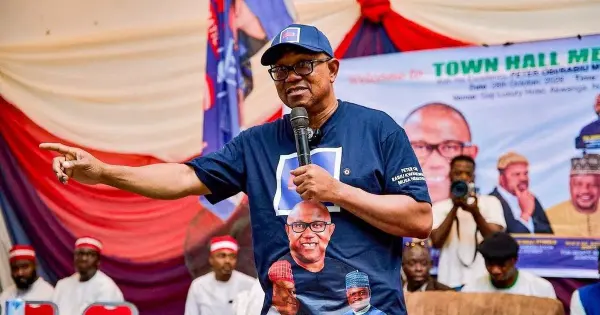
Peter Obi, the presidential candidate for the Nigeria Democratic Congress (NDC), has intensified his campaign for the 2027 general election by directly challenging President Bola Tinubu’s leadership. Speaking in Abakaliki, the capital of Ebonyi State, Obi highlighted a significant discrepancy in the President's availability, noting that while Tinubu has spent over 260 days outside Nigeria, he claims he cannot dedicate 36 days to campaign across the nation's states. This assertion forms the core of Obi's narrative, framing the current administration as lacking both the energy and the competence to govern effectively.
The Discrepancy in Presidential Availability
According to The Sun Nigeria, Obi's argument centers on the President's frequent international trips. The former Anambra State governor stated that President Tinubu has been out of the country for more than 260 days. In contrast, Obi questioned why the President refuses to spend 36 days touring the federation's states to engage with the public about his three-year track record. Obi demanded that Tinubu come to Abakaliki to explain how borrowed funds have been utilized and to account for the use of public money. By refusing to campaign in all 36 states, citing governance duties, the President has inadvertently provided Obi with a potent talking point regarding his dedication to the nation.
Obi further argued that the President's reluctance to engage in a full-fledged campaign tour suggests a lack of confidence in his own achievements. "President Tinubu does not have the competence to run Nigeria. He does not have the energy to run Nigeria. He should pack his things, go home and rest," Obi stated. This direct challenge aims to erode the President's credibility and position Obi as the active, engaged candidate who is ready to listen to the people.
A Seven-Point Emergency Plan
Beyond criticism, Obi outlined a comprehensive platform for his potential presidency, declaring seven specific areas where he would declare a national emergency if elected. This strategy is designed to address the most pressing issues facing Nigerians today.
- National Unity: Obi pledged to unite Nigeria, rejecting ethnic divisions such as Igbo, Yoruba, and Hausa identities as primary determinants for employment or political favor. He emphasized the implementation of federal character in all government jobs.
- Security: He promised decisive action against insecurity, stating that the government would be in charge of protecting lives and property. Obi specifically mentioned that security agencies would be equipped to defend the country, including in cases where children are kidnapped.
- Corruption: A major pillar of his plan is a fight against corruption. Obi stated that public money must be used for public good and warned that embezzlers, starting from the highest office, would face imprisonment.
- Education: With over 18 million children out of school, Obi declared an emergency to reduce this number and improve access to education.
- Hunger: He plans to support farmers in cultivating the nation's vast lands to ensure food security and boost exports, addressing the rising cost of food.
- Health: Obi committed to establishing functional healthcare facilities in every political ward of Nigeria, asserting that the country has the resources to achieve this.
- Power: While mentioned in the list of challenges, the specific details for the power sector emergency were part of the broader declaration to address the nation's infrastructural deficits.
Positioning for the 2027 Election
Obi's speech in Abakaliki was not just a local political event but a national statement. He explicitly warned against dividing the South East, urging voters to support him not because of his ethnicity or region, but because of his qualifications as the leading candidate for the presidency. "I don’t want the people of Ebonyi to vote for me because I am from the South East. I don’t want you to vote for me because I am an Igbo person," Obi said. "My dear people, I want you to vote for me because I am qualified to be the President of this country."
This approach is crucial for a candidate seeking a national mandate. By framing his candidacy around competence and national service rather than regional loyalty, Obi aims to attract a broader coalition of voters. His declaration that he is the "leading presidential candidate" reflects a growing confidence in his polling position and his ability to consolidate support ahead of the 2027 general election.
The Political Context
The 2027 election in Nigeria is shaping up to be a significant contest, with various political figures entering the race. Obi's strategy of aggressive campaigning and clear policy proposals contrasts with what he perceives as the President's retreat from public engagement. By highlighting the President's absence, Obi is effectively turning the incumbent's travel schedule into a liability. The political landscape in Nigeria is currently marked by economic challenges, including inflation and currency fluctuation, which makes Obi's focus on hunger, security, and economic recovery highly relevant to the average voter.
The Sun Nigeria's reporting underscores the intensity of the political discourse in the lead-up to the election. Obi's ability to translate his seven-point emergency plan into tangible policy actions will be key to his success. His challenge to Tinubu to explain the use of borrowed funds is a direct appeal to fiscal accountability, a topic that resonates strongly with Nigerians who have experienced the economic strain of recent years.
Why This Matters for Voters
For the Nigerian electorate, Obi's message offers a clear alternative to the status quo. The emphasis on security and corruption is particularly important, as these remain top concerns for citizens. The promise to jail embezzlers, including those in high office, is a bold statement that aims to restore trust in public institutions. Furthermore, the focus on education and health addresses fundamental human rights and quality of life issues that have been neglected.
Obi's campaign is not just about winning an election; it is about setting a new standard for presidential accountability and engagement. By demanding that the President explain his actions and by outlining a concrete plan for the future, Obi is positioning himself as a leader who is both responsive to the people's needs and capable of delivering results.
What is Peter Obi's main criticism of President Tinubu?
Peter Obi's primary criticism is that President Bola Tinubu has spent over 260 days outside Nigeria yet refuses to spend 36 days campaigning across the country's states. Obi argues this demonstrates a lack of energy and competence to govern, suggesting the President should leave office to rest.
What are the seven emergencies Peter Obi plans to declare?
If elected, Peter Obi plans to declare emergencies in seven areas: national unity, security, corruption, education, hunger, health, and power. These measures are designed to address the most critical challenges facing Nigeria, including inequality, insecurity, and infrastructural deficits.
Where did Peter Obi announce his 2027 campaign strategy?
Peter Obi announced his campaign strategy and detailed his seven-point emergency plan during a political summit in Abakaliki, the capital of Ebonyi State, in Nigeria.
The 2027 election will be a pivotal moment for Nigeria, and Peter Obi's campaign is already making a significant impact. His clear messaging and direct challenges to the incumbent have put him at the forefront of the political conversation. As the election approaches, voters will be watching closely to see if Obi can translate his popularity into a decisive victory and if his proposed emergencies will gain traction among the broader electorate. The contrast between Obi's active campaigning and Tinubu's perceived withdrawal from the political arena will likely be a defining feature of the next electoral cycle.